
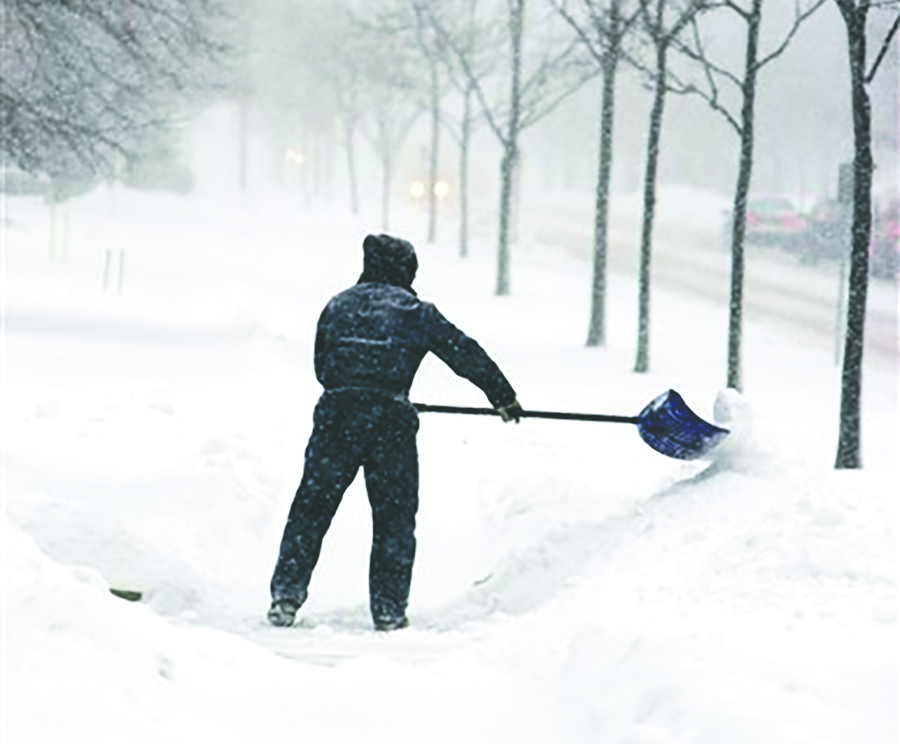
These past few weeks have been quite a challenge, with below temperatures, increasing snow accumulations and problems with travel, due to salt shortages.
Winter Storm Fern hit the area January 24-26. According to the National Weather Service:
Saturday, January 24, no measurable snow, but temperatures dipping to -11 and wind chill to -14.
Sunday, January 25, about ten inches of snow fell, with winds gusting to 17 miles per hour.
Monday, January 26, several more inches of snow fell throughout the morning and afternoon, with temperatures of 12 to 15 degrees and winds gusting to about 15 miles per hour. Monday evening, extreme cold warning, with wind chills of 20 to 25 below zero expected. The storm closed schools, businesses and delayed rubbish removal.
Although the area has experienced rather mild winters lately, many can remember harsh winters in the past. Many remember January 26, 1978. The historic blizzard was named the worst winter storm in Ohio history. Winds up to 82 MPH and snow drifts up to 25 feet, with wind chills down to -50 degrees, caused much damage.
The City of North Royalton Service Department operates a three-shift schedule from December through March in order to respond to events such as this. “During a snow event, plowing and salting primary main roads, hills and curves are given top priority. Secondary main roads and subdivisions are cleared once all the critical areas are completed. Depending on the severity of the snow event, our City is sectioned into 4, 5 or 6 truck routes using main roads as divisional boundaries. The Service Department is committed to keeping our roads as safe as possible, but no guarantee can be given that the roads will be completely clear of snow and ice,” according to the city’s website. Cul-de-sac plowing is generally performed as the last function of snow removal and is plowed using pick-up trucks. North Royalton has over 230 cul-de-sacs, which are divided into 6 routes.
North Royalton Service Director, Nick Cinquepalmi explained that “of course, the main roads are the top priority and we have a lot of hills, such as Rt. 82, Bennett Road, Akins Road. The main roads, the hills, and Rt 82 have to be always cleared. During a normal snow we can accomplish all of that, then go into side streets, then the developments. At some point, we are always mindful of keeping an eye on the main roads. With the snow falling two inches an hour, as soon as you’re done, you have to do it again. With 15-16 inches of snow falling in a ten-hour period, it is almost impossible to maintain.”
To complicate the harsh winter weather, North Royalton, along with Cleveland and other local communities have been experiencing a salt shortage. It was not that the city was remiss in their duty to coordinate the supply for North Royalton. North Royalton City Council adopted legislation in May of last year, accepting the bid of Cargill for salt for the 2025-26 season. The bid covered the year from November 1, 2025 to October 31, 2026. Morton Salt and Compass Minerals also partially bid, but cost much more than Cargill. Neither Morton, nor Compass bid on treated road salt.
On January 21, the city posted the following:
“Our salt supplier Cargill, a major provider to dozens of other municipalities and agencies in the region, is experiencing supply and demand issues with salt. Our contract with Cargill has a 72-hour delivery provision. We ordered 1,000 tons of salt on Thursday last week and received only 300 tons, due to back-order issues cited by Cargill. Our Service Department has been in direct communication with Cargill, and has been told we are likely not receiving salt this week or next, possibly longer. This is not an issue specific to North Royalton, this is impacting anyone supplied by Cargill. We currently have 400 tons in reserves in our barn. An average three-day snow event can consume 1,500 tons. Our Service Director has been on top of the situation and has been rationing salt for three-plus weeks. That will continue. Salt will be conserved for mains, hills and curves. Streets will be plowed, but salt will be rationed.
“Cargill released a statement saying that winter weather hit early this year in many parts of the country – sometimes early and sustained snow and ice requires producers to prioritize distribution of salt to ensure public roads stay safe. We have confidence in the strength and resilience of our supply chain and our ability to safely produce deicing salt that keeps roads safe and commerce moving. Our production facilities and supply chains are running strong. At Cargill, the safety of our employees and the communities where we work and live is our number one priority. Cargill has delivered roughly 75% of Cleveland’s contracted salt volume for the year and we are only 64% of the way through the season, and contract term —meaning we are delivering a high volume early in the season,” the statement said. “The remaining volume represents about one-quarter of the contract, and the majority of those orders were submitted only recently. We remain fully on track to meet the contract by May 31, 2026.”
On January 28, the city posted the following:
“Our salt supplier Cargill, a major provider to dozens of other municipalities and agencies in the region, is still experiencing supply and demand issues with salt. Our Service Director Nick Cinquepalmi has been in constant communication with Cargill, who indicated we are on their delivery schedule next week to receive the backorder of 650 tons we still need from the 1,000-ton order we placed on Jan. 15. We hope to receive an additional order, as well. . . . We will continue to conserve salt, so that Cargill can get caught up with our deliveries to restock our barn. This means salt will be prioritized for mains, hills and curves. We appreciate your patience as our crews do what they can to keep the roads as clear as possible.”
Residents can help out by remembering the following:
• Stay about four car lengths behind the plow truck. Never pass a plow truck on the right.
• Do not park on the street or in cul-de-sacs during snow events, as it prevents the plows from properly clearing the roads.
• Do not push snow into the street or across the road. Residents and private contractors should be aware of City Ordinance 660.15 (a). This section of the code states, “No person, company, contractor, or private snow removal company or entity while in the process of snow plowing or removal shall deposit or cause to be deposited any snow and/or ice that would obstruct, hinder, block or cause injury to any public or private road, sidewalk, driveway, fire hydrant, or to the landscaping of any property. All snow from any premises shall be deposited onto the same premises from which it was moved, plowed or removed.” Any individuals who do could be subject to citation.
• To help minimize snow being plowed onto your apron, “it is recommended as much snow as possible be placed on the side of your driveway away from the direction of the snow plow (the right side when looking at your house when standing at the street) and make a pocket on the left side of your driveway. In so doing, snow accumulation on the plow will drop into that pocket and the potential for large quantities of snow being deposited into your driveway apron is reduced,” according to city officials.
According to the city’s website, the city will repair or replace mailboxes if damaged by city snow plows. It will also repair tree lawns in the Spring, if damaged by city snow plows. Residents should contact the Service Department in these instances at 440-582-3002. “The Service Department will come out as soon as possible to repair or replace mailboxes. If minor damage has occurred, we will repair your current mailbox. If your mailbox and/or post needs to be completely replaced, the City will install either a standard metal mailbox and/or wood post or a Step2 mailbox. We do not have a reimbursement program. Please note: at times we may leave you a temporary mailbox so that you can continue to receive mail service until we can repair or replace your mailbox,” according to the city’s website.
Residents are asked to clear snow and debris away from fire hydrants, as well as from mail boxes so house numbers are visible, enabling the safety services the fast possible access to your home, in case of emergency. “In an emergency, every second counts,” noted North Royalton Fire Department officials. “Fire hydrants that are blocked, concealed, or difficult to access due to snow or ice and impede emergency fire response. Fire trucks carry a limited amount of water, so one of the first tasks upon arriving at a fire is to locate a water supply from the nearest hydrant. Hydrants covered in snow can be difficult to locate, and uncovering them can waste valuable time needed to fight the fire. Keeping them clear can mean easier access to water and more time doing what really matters – fighting the fire.” Residents are asked to clear a path from the street to the hydrant and a perimeter of about three feet around the hydrant.
The Fire Department also recommends that residents clear the snow and ice from the gas meter or furnace vent. “A covered meter or vent can cause your furnace and hot water heater to stop working. Before it stops working, it can lead to carbon monoxide building up in your home,” according to Fire Department officials.
By GLORIA PLEVA KACIK
Contributing Writer